How synthetic borrowers are gaming AI-driven loan underwriting
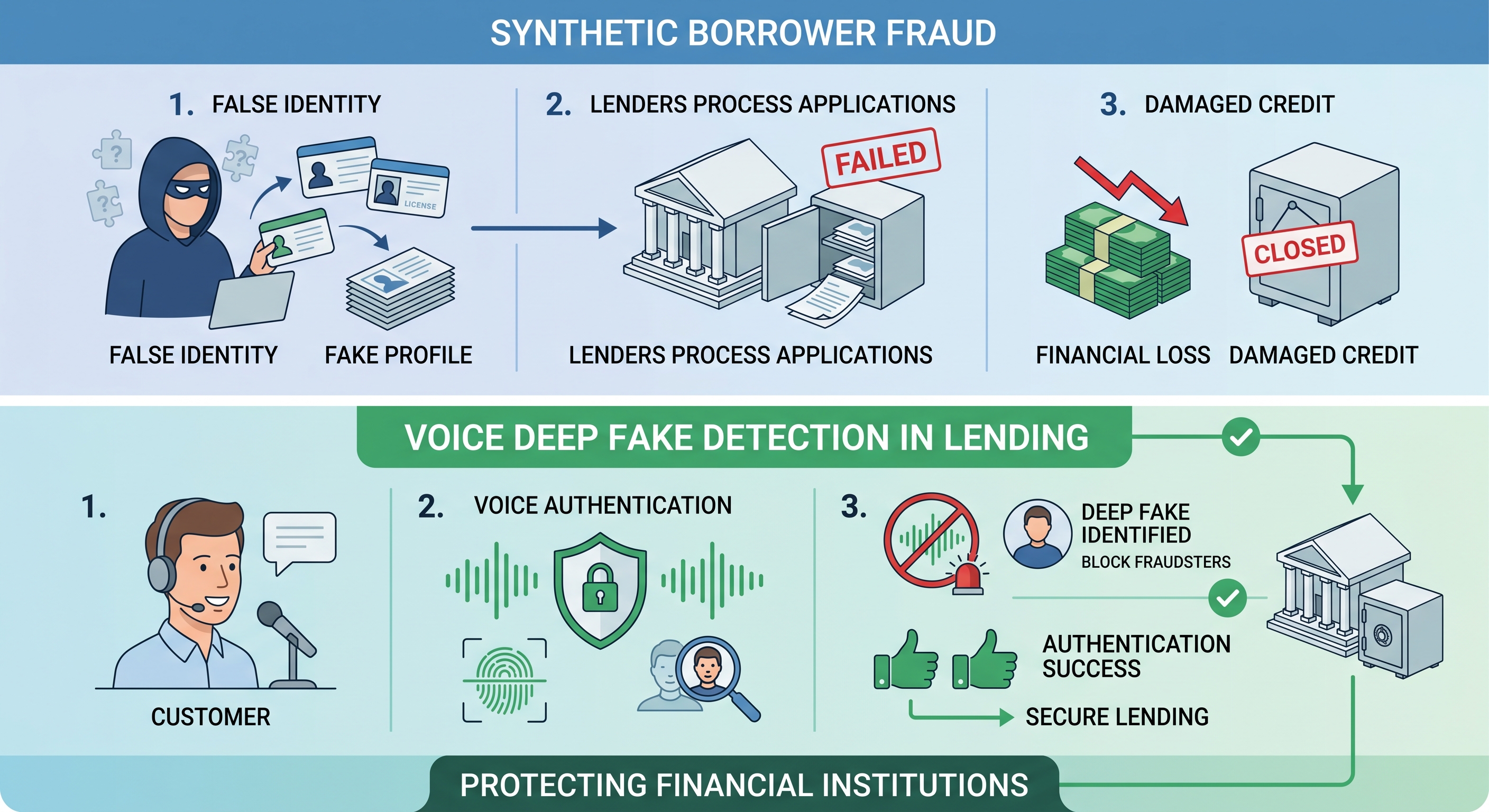
A synthetic borrower can open a loan account, pass identity verification, get funded, and vanish before a human underwriter ever questions whether the applicant was real. Deepfake identity fraud is projected to jump 495% in 2026, according to Shufti's Identity Fraud Index, with document deepfakes alone expected to grow nearly 40x over 2025 levels. Nowhere is that surge more dangerous than in lending, where fraud teams are discovering that the customers who look the most "perfect" on paper are often the ones who don't exist at all.
The rise of the "perfect" synthetic customer
Traditional fraud models are built to flag anomalies: mismatched addresses, inconsistent income, unusual login locations. Synthetic borrowers are engineered to do the opposite. As PYMNTS reported, fraudsters now combine deepfakes, cloned voices, fabricated employment records, and AI-generated financial behavior to create borrowers engineered to look like statistically ideal applicants — the exact opposite of what anomaly-detection systems are trained to catch. Credit unions and fintech lenders are seeing fraud spread across the entire member lifecycle, from account opening through authentication and transaction activity.
Anatomy of a 2026 deepfake loan application
A synthetic identity used to target a lender today rarely relies on a single fake document. It's a stack of AI-generated evidence designed to survive every stage of onboarding:
- AI-generated government ID — a driver's license or passport produced by an image model, built to pass automated document checks.
- Fabricated employment verification — AI-written HR correspondence and pay stubs that corroborate a fictional job history.
- Deepfake video onboarding — a synthetic face synchronized with a cloned voice during a "live" identity verification call.
- Synthetic transaction history — AI-modeled financial behavior designed to build a credit profile that looks statistically unremarkable.
Why this fools automated underwriting
Machine-generated identities are purpose-built to distort the exact signals credit models rely on. When the input data is fabricated to be "normal," fully automated lending pipelines have little basis left to challenge it — the fraud isn't an outlier in the data, it is the data.
The blast radius goes beyond lending
Synthetic identity is only one branch of a much bigger problem. Identity Week's coverage of the same research notes that 2026 is on pace for a sixfold jump in deepfake fraud attempts overall. And the stakes aren't limited to retail lending: earlier this year, a multinational firm lost $25 million after an employee joined a video call populated entirely by deepfaked avatars of its own CFO and board members — a reminder that the same synthetic-media techniques used to fool underwriting can just as easily target treasury and payment authorization.
Closing the gap with voice-to-face detection
Document forensics and liveness checks alone can't keep pace with generative models that improve every quarter. What catches a synthetic borrower is confirming that the voice, the face, and the behavior on an onboarding call actually belong to one real, consistent person — not three separate AI-generated components stitched together.
Corsound AI's Voice-to-Face AI matches a caller's voice directly to a face without needing a pre-enrolled database, catching identity mismatches that document checks miss entirely. Paired with Deepfake Detect, which analyzes audio and video in real time for the artifacts generative models leave behind, lenders get a way to flag synthetic applicants at the moment of onboarding — before funds are ever released.
As deepfake identity fraud accelerates through the rest of 2026, lenders that rely solely on document checks and static credit signals will keep losing to applicants engineered to look ideal. See how Corsound AI helps banks and fintechs prevent identity fraud before a synthetic borrower ever reaches funding.
See Corsound AI Voice Intelligence In Action